August 8, 2026
From Memes to Missions: Building Decentralized Global Impact with CrabStar
Crypto has already proven something remarkable.
People who have never met, live in different countries, speak different languages, and operate under completely different financial systems can organize around a shared network. They can provide liquidity.
Build products. Create culture. Govern protocols. Fund development. Move billions of dollars.
All without needing to belong to the same company, country, or institution. We call them decentralized communities.
But we believe we’ve only just begun to understand what these communities are capable of. Because if decentralized communities can coordinate capital at a global scale, why can’t they coordinate impact at a global scale too?
That question is the foundation of what CrabStar is exploring: Using decentralized communities and DeFi to create decentralized global impact.
Crypto Solved Coordination. What Comes Next?
One of blockchain’s greatest achievements isn’t cryptocurrency itself. It’s coordination.
Blockchains allow thousands—or millions—of people to participate in the same economic network without requiring a centralized authority to maintain trust.
DeFi expanded that further. Capital became programmable. Transactions became transparent. Treasuries became verifiable.
Economic rules could be written directly into protocols. And that unlocks something we don’t think has been fully explored yet.
What if creating positive impact wasn’t something a crypto project decided to do after it became successful?
What if it was embedded into the system from the beginning? Not:
“If we make enough money, we’ll give some back later.”
But:
“When this ecosystem creates value, part of that value is automatically directed toward its mission.”
That’s a fundamentally different model.
Impact at the Protocol Level
This distinction matters.
Impact shouldn’t be a marketing campaign.
It shouldn’t depend on founders remembering to allocate funds. And communities shouldn’t have to rely on blind trust to know whether anything actually happened.
The long-term opportunity is to move impact closer to the protocol and infrastructure layer. To build the rules into the system itself.
Imagine an ecosystem where economic activity can automatically contribute toward multiple objectives:
- Community participation
- Ecosystem development
- Product growth
- Real-world mission funding
These flows can be defined in advance.
Wallets can be public.
Transactions can be visible.
Treasuries can be monitored in real time.
Receipts can live permanently on-chain.
The community doesn’t have to ask:
“Did this actually happen?”
They can verify it themselves.
That’s where blockchain becomes powerful in a way we’re only beginning to explore.
From Trust Me to Verify It
Traditional philanthropy depends heavily on institutional trust.
Crypto offers an alternative: verifiable impact infrastructure.
If value moves from a protocol into an impact treasury, that transaction is visible.
If funds accumulate, anyone can see it.
If funds are deployed, that is also visible.
Over time, real-world partners, milestones, and outcomes can be connected to the same transparent financial layer.
This doesn’t eliminate the complexity of measuring real-world impact.
Blockchain cannot prove an ocean was cleaned or an ecosystem was restored.
But it can radically improve the transparency of the financial systems supporting those efforts.
And that distinction is where meaningful innovation begins.
Why Community Must Be Part of the Model
There’s another side to this.
Impact cannot come at the expense of the people building the ecosystem. Because in crypto, communities are not passive audiences.
They are the engine.
Someone creates the meme.
Someone hosts the Space.
Someone writes the thread.
Someone welcomes the newcomer.
Someone finds the bug.
Someone builds the tool.
Someone makes the introduction.
Someone shows up every day when no one is watching.
Traditional systems primarily reward employees and shareholders.
Crypto allows something broader: contributor economies. Attention has value.
Culture has value.
Distribution has value.
Contribution has value.
If decentralized communities are creating that value, then systems should exist to return value back to them.
That’s why community rewards and global impact are not competing ideas.
They are the same system working in different directions.
Create value. Reward contributors. Reinvest into infrastructure. Direct a portion toward a shared mission. Repeat.
That is the flywheel.
Why Ocean Conservation?
For CrabStar, that first mission is ocean conservation. And there’s a reason for that.
The ocean is inherently global. It does not recognize borders.
Marine ecosystems cross jurisdictions. Pollution travels.
Currents connect continents.
Wildlife migrates across entire oceans.
Damage in one region can affect ecosystems thousands of kilometers away.
No single country owns the problem. And no single country can solve it.
That makes the ocean structurally similar to decentralized networks:
Global participants. Shared resources. Shared responsibility. Shared outcomes.
A blockchain has no borders. Neither do the oceans.
If we are going to experiment with decentralized global impact, there are few better places to begin.
The Meme as the Front Door
In crypto, memes are often misunderstood.
They are not the end goal.
They are coordination tools.
They spread ideas.
They create identity.
They simplify complexity.
They turn strangers into communities.
The mistake is not using memes.
The mistake is assuming the meme must be the destination.
What happens when the meme becomes the front door instead?
People arrive because it’s engaging.
They discover a community.
The community discovers infrastructure.
The infrastructure creates economic activity.
That economic activity funds participation and supports a shared mission.
Suddenly, something that started as a meme becomes a coordination network.
That is the experiment behind CrabStar and the broader ecosystem it is part of.
The meme is not the finish line.
It is the entry point.
One Network. One Purpose.
The long-term goal is not to create isolated tokens or disconnected experiments.
It is to build a connected ecosystem where products, communities, and infrastructure all contribute toward the same underlying mission.
Today, that might be a token.
Tomorrow, it might be software. Analytics. Community tools. DeFi products. Applications. Protocols. Partnerships.
Entirely new systems we haven’t imagined yet. Different entry points. Different ways to contribute. Different forms of value creation.
But underneath it all: One network. One community. One mission. One transparent impact layer.
As the ecosystem grows, the flywheel strengthens.
Crypto Doesn’t Need Another Promise
Crypto has had enough promises. What it needs are systems. Transparent systems. Verifiable systems.
Systems where accountability is not dependent on trust, personality, or marketing.
This is the shift CrabStar is interested in: From
“Trust us, we’ll give back.”
to
“Here are the rules. Here are the wallets. Here are the transactions. Verify it yourself.”
That is much closer to the original ethos of crypto than anything we’ve seen in recent cycles.
Build a Better Model
People don’t stay in communities because of tokenomics alone.
They stay because they develop identity. They build relationships. They contribute. They feel part of something larger than themselves.
The strongest movements in crypto have always understood this.
So the message is not: Buy the token.
It is: Build a better model.
A model where communities are not disposable.
Where contributors participate in the value they help create. Where transparency is infrastructure, not marketing. Where DeFi does not stop at capital movement.
And where decentralized communities can coordinate around problems far larger than themselves.
Crypto has already shown us that strangers around the world can coordinate money.
The next question is more important: What happens when we coordinate purpose?
That is the future CrabStar is building toward.
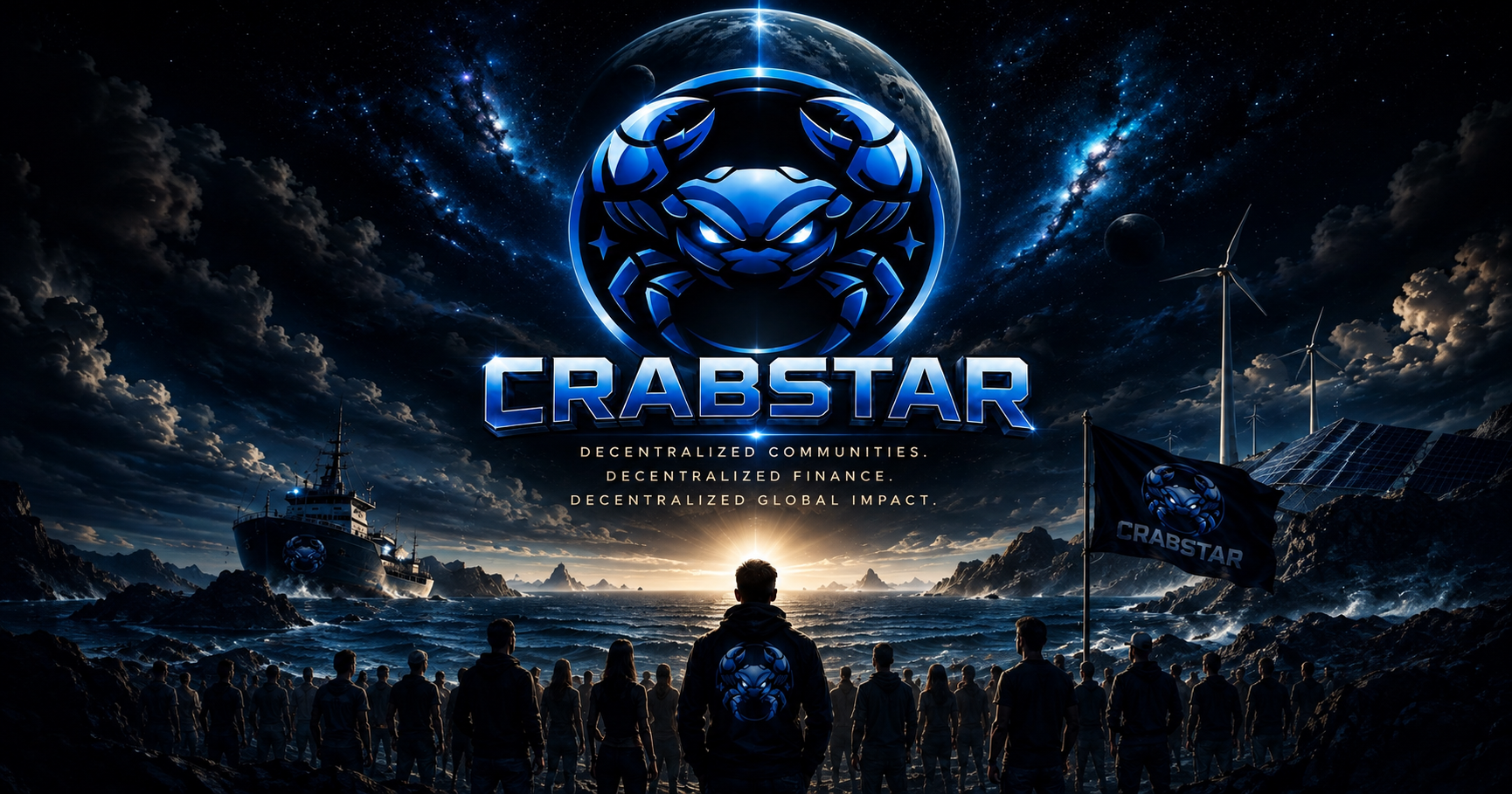
Decentralized communities. Decentralized finance. Decentralized global impact.
And it starts with the ocean.
NOVEMBER 1, 2026
That is launch day. $CRAB goes live on Solana.
We are working flat out to get there. The audit, the multi-sig, the liquidity lock: all of it is on the roadmap above, and the receipts go public as each piece lands.
One honest note, because it belongs on every page like this: this market is high risk and nothing here is financial advice. Do your own research.
Then, if CrabStar holds up to your standards, be there on day one with us.
Get launch updates. No spam, just the drops that matter.